Hiring chairs feels like one of the easier things on the wedding planning list. Pick a style, count your guests, place the order.
It’s a bit more involved than that — not complicated, just worth thinking through properly before the day rather than on it. Here’s the full checklist.
1. Work out your actual chair count — not just your guest count
120 guests doesn’t automatically mean 120 chairs. Think through everywhere chairs are needed across the whole day. You may need seating for the ceremony, the wedding breakfast, the top table, musicians or performers, any suppliers eating as part of their package, and the occasional unexpected plus one who wasn’t on the final list.
If ceremony and reception are in different spaces, decide early whether the same chairs are moving between them or whether you’re hiring two sets. That decision affects everything else.
Order a small buffer of 5 to 10 extra chairs depending on your wedding size. Guest lists shift. It costs very little and saves real problems on the day.
2. Choose a chair that works in your actual venue
A chair that looks perfect in a product photo can look completely different inside your venue. What matters isn’t which chair you like in isolation — it’s which chair works when there are 150 of them inside a specific room with specific lighting, flooring, and table settings.
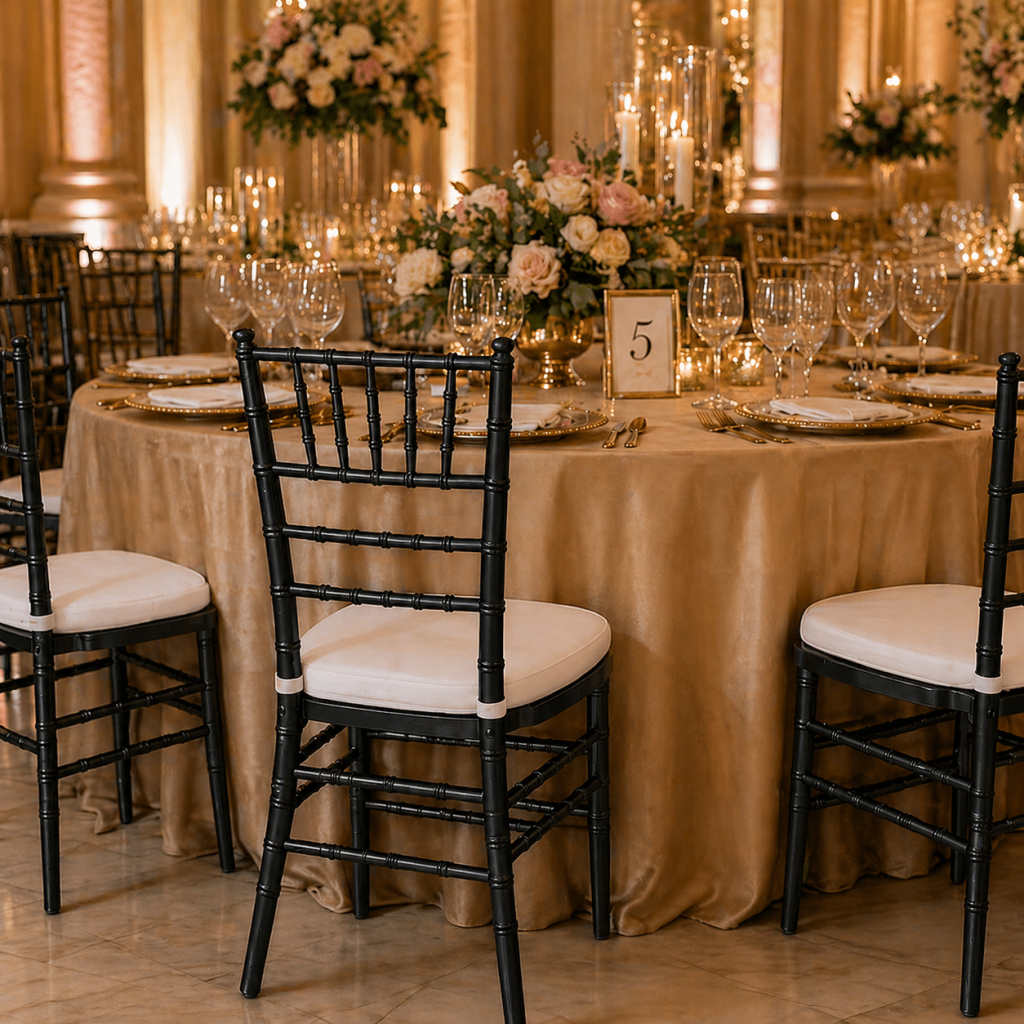
Gold Chiavari chairs suit hotel ballrooms with warm lighting and formal table settings. Limewash works well in barns, marquees, and outdoor settings where the décor leans natural and organic. White suits bright, airy spaces and outdoor ceremonies. Black works for contemporary venues and evening events where you want strong contrast.
If you’re unsure, describe the venue and styling direction to your hire company and ask for a recommendation. A decent supplier will have seen the combination before and will tell you what works.
3. Ask about the actual chairs you’ll receive — not just the photos on the website
This matters more than people expect. A supplier’s website might show beautiful chairs. The chairs that turn up might be a different story.
In a room of 150 gold Chiavari chairs, you’ll immediately notice if some are bright gold, some are faded, and others are scratched or marked. The inconsistency is obvious at scale in a way it isn’t in a single product shot.
Before booking, ask directly how chairs are checked before delivery, whether damaged chairs are removed from hire stock, whether chairs come from a consistent batch, and what condition the cushions are in. The chairs don’t need to be new. They need to be clean, stable, and consistent across the full order.
4. Confirm whether cushions are included and what colours are available
Cushions are often quoted separately or not mentioned at all. Don’t assume they’re included — ask.
Find out which colours are available, whether alternatives cost more, and whether the cushions will be clean and consistent across the order. A grubby or mismatched cushion is one of the most visible things in a room full of chairs, and it sits at exactly the height your guests look at during a three-course meal.
Ivory or white works with most palettes and is the safe default. If you’re working with a specific colour scheme, check what the supplier stocks before assuming you can get what you want.
5. Make sure the chairs actually fit around your tables
Your venue capacity and your comfortable seating capacity are not the same number. Squeezing one extra chair onto every table saves space on the floorplan and makes the room uncomfortable in real life.
Check that there’s enough space behind seated guests for people to move their chairs, that waiting staff can move between tables easily, and that access routes to the dance floor and emergency exits stay clear. Ask your venue for a floorplan and mark up the layout properly before finalising numbers.
6. Confirm what setup is actually included in the quote
Delivery and setup are not the same thing. Some suppliers deliver to an agreed point and leave. Others set the whole room up. Make sure you know which one you’re getting.
If setup is included, confirm exactly what that covers — ceremony rows, dining tables, top table, cushion placement, and a final alignment check. For a 200-guest wedding the difference between delivery-only and full setup is not small.
If your venue is responsible for setting up the chairs, tell them in advance and make sure everyone is clear on it. The morning of the wedding is not the time for the venue coordinator and the hire company to discover they each assumed the other was arranging 200 chairs.
7. Find out your venue’s delivery restrictions before your supplier does
Most venues have rules around supplier access. Central London hotels often require deliveries through specific loading bays, goods lifts, or pre-booked slots. Country houses and heritage venues have their own restrictions. Marquee sites can have access arrangements that aren’t obvious until someone tries to get a van down a single-track estate road.
Ask your venue specifically what time suppliers can arrive, where they unload, and whether there are any access restrictions. Give that information to your chair hire company before they plan the delivery — not on the morning itself.
8. Make sure there’s enough time between delivery and guests arriving
A 1pm delivery for a 2pm ceremony gives you one hour. That sounds reasonable. In that hour, chairs need to be unloaded, brought into the venue, distributed, arranged into rows, cushions placed, alignment checked, and the area cleared before guests come through.
For a large wedding that’s tight. A traffic delay, slow venue access, or a busy goods lift can eat into that time quickly. Build in more buffer than you think you need — particularly for London venues where traffic and access restrictions are genuinely unpredictable.
9. If you’re reusing ceremony chairs for dining, plan the room flip properly
Reusing the same chairs for ceremony and reception is sensible when the logistics work. When they don’t, it creates problems.
Ask yourself how much time there is between the ceremony ending and guests sitting down for dinner, who is actually moving the chairs, whether guests will be walking through the space while it’s being reset, and whether the venue allows furniture to be moved between areas.
Don’t make the decision on cost alone. If the turnaround is 20 minutes and the chairs are in two different buildings, hiring separate sets is the right call regardless of the price difference.
10. Plan the ceremony aisle before the chairs go in
Rows of chairs either side of an aisle sounds simple. It isn’t always.
The aisle needs to be wide enough for the couple, the wedding party, and any train or dress volume. It also needs to work for the photographer and videographer, and for guests moving in and out. If your florist is adding column arrangements or pew ends along the aisle, those reduce the effective walkway width — sometimes by more than people expect.
Agree the layout with your venue, florist, and planner before the chairs are installed. Adjusting it after the fact wastes time and creates stress on a morning that already has enough of both.
11. Think about accessibility from the start, not as an afterthought
Wheelchair spaces and accessible seating shouldn’t be added after everything else has been arranged. They should be part of the floorplan from the beginning.
Also consider older guests who may find tightly packed tables or long walking distances difficult, and anyone who might need to be seated near an exit or accessible facilities. Good event seating means everyone can use it comfortably — not just the guests who don’t have any specific requirements.
12. Ask what happens if your numbers change
Guest lists shift. They almost always do. Before confirming your booking, find out when the final count needs to be confirmed, whether you can add chairs close to the event, and whether matching stock would be available if you need a different quantity at short notice.
That last point matters more than people realise. If you’ve booked a specific finish during peak season and suddenly need 30 more chairs a week before the wedding, those chairs may not exist to be had. The earlier you communicate changes, the easier they are to solve.
13. Sort the collection arrangement before the wedding, not after it
Everyone thinks about delivery. Collection is just as important and causes more last-minute problems than it should.
Your venue may need everything out that night, first thing the following morning, or within a specific window. Some London venues have another event the next day and won’t allow furniture to be left overnight. Confirm the collection time before booking. Find out who provides access for the collection team if it’s happening after midnight. Make sure your hire company knows all of this.
A 1am discovery that the venue needs everything out but your collection was booked for 9am the next morning is avoidable — but only if you’ve asked the question in advance.
14. Compare the full cost, not just the per-chair rate
A low per-chair price that excludes delivery, setup, and collection can easily cost more in total than a higher per-chair price that includes everything.
When comparing quotes, ask each supplier for a total all-in price for your specific event — chairs, cushions, delivery, setup, collection, and any London access or parking charges. That’s the number that tells you what you’re actually paying. The per-chair rate on its own tells you very little.
15. Book earlier than you think you need to
Peak summer Saturdays — particularly May through September — fill up faster than most couples expect. Specific finishes like limewash are in high demand and not all suppliers stock them in large quantities. If you have a summer Saturday date and a particular style in mind, book as soon as your venue and approximate numbers are confirmed.
You can usually adjust quantities later. You can’t create stock that doesn’t exist.
The short version: wedding chair hire is straightforward when it’s planned properly. The problems happen when delivery times aren’t confirmed, setup responsibilities aren’t clear, or numbers change at short notice without anyone having asked what the process is. Work through this list before you confirm, and most of those problems don’t happen.
If you have a date, a venue, and an approximate guest count, that’s enough to get started. We’ll work through the rest with you.
Planning an event?
Skip the reading and get a price. Send your date, venue and rough numbers.
Get a quote