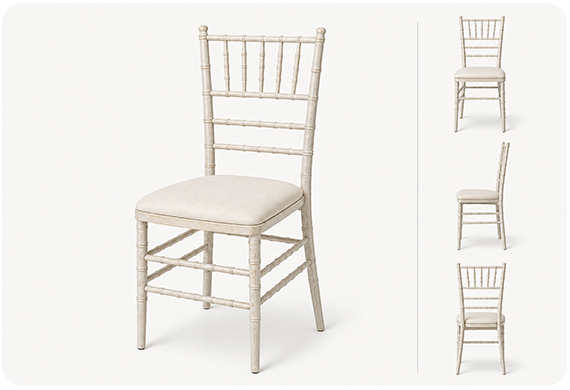
The Chiavari chair is one of the few pieces of furniture still in regular use that has barely changed in over two centuries. The chair you’ll sit on at a London wedding next summer is, in almost every detail, the chair Giuseppe Gaetano Descalzi designed in a small Italian coastal town in 1807.
That’s unusual. Most furniture from the early 19th century either disappeared, was reinvented beyond recognition, or survives only as antique pieces in museums. The Chiavari chair survived because it got something right at the start that nobody has since managed to improve on.
Here’s how it happened.
The town of Chiavari
Chiavari is a small port town on the Ligurian coast in northwest Italy, roughly 40 kilometres south-east of Genoa. In the early 1800s it had a population of around 10,000, a working harbour, and a tradition of skilled craftsmanship — woodwork, lace-making, and shipbuilding among them.
The town gave its name to the chair, but the chair gave its name back to the town in a more lasting way. Today, “Chiavari” is recognised internationally as a chair style rather than as the place. Most people who know the chair don’t know the town exists.
Giuseppe Gaetano Descalzi
Descalzi was a Chiavari-born cabinetmaker, born in 1767. By his late thirties he was running a workshop in the town producing furniture in the styles fashionable in Liguria at the time — a mix of French neoclassical influence and Italian provincial work.
The commission that produced the Chiavari chair came in 1807 from the Marchese Stefano Rivarola, a local nobleman and diplomat. Rivarola had recently returned from Paris with a set of French chairs in the Empire style — light, elegant, expensive. He asked Descalzi to copy them.
Descalzi didn’t copy them. He redesigned them.
The French chairs were heavy by the standards of what they tried to be. The wood was thick, the joinery conservative, and the finished chair weighed more than a chair of that scale needed to. Descalzi looked at the design and worked out that he could keep the proportions and the elegance while removing significant weight, by reducing the thickness of the timber and reworking the joinery to take the loads more efficiently.
The result was the first Chiavari chair: light enough to lift with two fingers, strong enough to take an adult’s weight, and visually almost identical to the more expensive French original.
Why it succeeded
The Chiavari chair worked because it solved a problem that mattered to the people buying chairs in the early 19th century: how do you furnish a large room without filling it with heavy furniture?
Italian and French upper-class dining and reception rooms of the period needed dozens of chairs that could be moved, stacked against walls, and rearranged for different uses. Heavy chairs were a logistical problem. The Chiavari design — under 3kg per chair, stackable in tight columns, structurally sound — solved the problem without sacrificing the look.
Within a decade of the first chair being made, Descalzi’s workshop and several others in Chiavari were producing them in volume. The chairs were exported across Italy, then France, then further. By the mid-19th century, “Chiavarine” chairs were a recognised category of furniture in trade catalogues across Europe.
The design details that matter
Three things make a Chiavari chair a Chiavari chair, and all three are original to Descalzi’s 1807 design.
The frame. Four turned legs, two of which extend up to form the back supports. A curved top rail, a stretcher on each side, and a curved back splat. The whole structure is held together with mortise-and-tenon joints rather than screws or brackets. Done well, it’s strong without being heavy.
The seat. Originally rush, hand-woven by craftsmen (often women working from home in the Chiavari area). The rush seat is part of why the original chairs are so light — it removes the need for the heavier wooden seat panel that most chairs of the period used.
The proportions. This is the part that’s hardest to describe and easiest to copy badly. The relationship between the seat height, the back height, the curve of the back splat, and the angle of the back supports is specific to the original design. Cheap modern reproductions often look “almost right” because they get one of these proportions wrong by a few millimetres.
The original beech frames were finished with a clear varnish that showed the wood grain. Gold leaf, paint, and lacquer finishes came later, as the chair spread beyond its original audience.
How it spread
The Chiavari chair reached the wider European market through a few specific routes.
In the 1820s and 1830s, Italian unification movements were drawing diplomats and intellectuals through Genoa and the Ligurian coast in significant numbers. Many of them bought Chiavari chairs to ship home. The chairs were small enough to pack efficiently, light enough to ship cheaply, and elegant enough to fit into European drawing rooms.
By the mid-19th century, Chiavari chairs were appearing in court furnishings, hotel ballrooms, and the homes of wealthy families across Europe. The Vatican is documented as having ordered Chiavari chairs in this period for various ceremonial uses, which gave the chair a level of prestige association that lasted into the 20th century.
In the 20th century, two specific developments expanded the chair’s reach further.
Catering hire. As large hotel weddings and corporate banqueting grew through the 1920s and 1930s, catering companies looked for chairs they could hire out in volume. Chiavari chairs were ideal: light enough to transport, attractive enough to suit formal events, and stackable enough to store in numbers. Hire fleets of Chiavari chairs became a standard part of the European catering industry.
Reproduction in resin. In the late 20th century, manufacturers (initially in the United States, then in China and Italy) developed resin and reinforced plastic versions of the Chiavari chair. These were cheaper to produce, lighter still, and more durable for hire use. They allowed the chair to be sold to wedding markets at price points the original wooden chair couldn’t reach.
The original Chiavari workshops in Italy still make wooden chairs by traditional methods. Many fleets you’ll encounter at UK weddings today are a mix of wooden and resin chairs, and a few specialist suppliers still hire only originals.
How it became the wedding chair
The Chiavari chair’s role as the default wedding chair is a relatively recent development — mostly the last 30-40 years.
For most of the 20th century, wedding chair hire in the UK meant utilitarian folding chairs, banqueting chairs from hotel stock, or chair covers thrown over whatever the venue happened to have. Chiavari chairs existed in the high-end hire market, but they weren’t dominant.
Two things changed.
First, the rise of “destination” wedding aesthetics from the 1990s onwards — Italian, French, and Tuscan-inspired weddings — put the Chiavari chair in front of a much wider audience. Wedding magazines and, later, Pinterest, made the chair a signal of a particular kind of elegant, European-inflected wedding.
Second, the resin reproduction industry made the chairs affordable enough to hire for ordinary weddings rather than just luxury events. Where a wooden Chiavari chair might once have been a £5-6 per chair hire, a resin version could be hired for £2-3, putting it within reach of mid-budget weddings.
The result is the situation today, where the Chiavari chair is the most-hired wedding chair in the UK, by some distance. Gold, white, and limewash finishes dominate. Black and clear (ghost) versions exist as alternatives for specific looks.
What hasn’t changed
Two centuries on, the Chiavari chair still does what Descalzi designed it to do.
It’s still light enough to move easily. It’s still strong enough to take an adult’s weight. It still looks elegant in a room without dominating it. It still stacks for storage.
The original beech-and-rush construction has been joined by gilt-finished wood, painted wood, limewashed wood, polished resin, and clear polycarbonate. The applications have expanded from Italian noble households to global wedding markets. The price has fallen, the production has industrialised, and the chair has become commonplace in a way Descalzi could not have anticipated.
But the chair itself — the shape, the proportions, the visual logic — is the same chair he made for the Marchese Rivarola in 1807. Nobody has improved on it because there isn’t much to improve.
That’s a rare thing in furniture, and worth recognising the next time you sit down at a wedding.
The chair we hire today
Our fleet includes both wooden and resin Chiavari chairs across five finishes: gold, white, black, ghost, and limewash. The limewash chairs are wooden, finished using a traditional technique that emphasises the grain. The gold, white, and black are resin reproductions that match the proportions of the original design.
Whether you’re hiring 20 chairs for an intimate ceremony or 300 for a hotel ballroom, you’re hiring a chair with a longer continuous history than most of the venues you’ll see it in.
It’s worth knowing where it came from.
Planning an event?
Skip the reading and get a price. Send your date, venue and rough numbers.
Get a quote