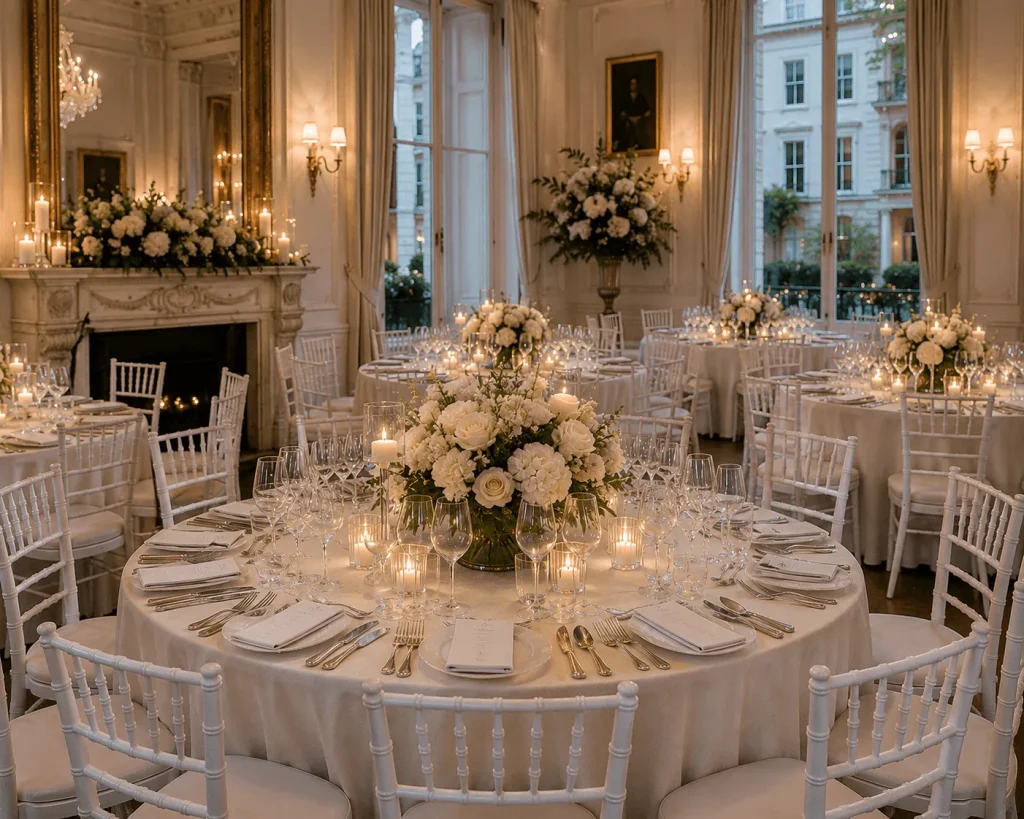
Your wedding ceremony is one of the most important moments of the day, but the way guests are seated can have a surprisingly big impact on how that moment feels.
A traditional straight aisle creates a formal entrance and a clear focal point. Curved seating can make the ceremony feel softer and more intimate. A semi-circle brings guests closer to the couple, while alternative layouts can transform an otherwise ordinary venue into something distinctive.
However, choosing a ceremony seating layout isn’t just about appearance.
You also need to consider how guests enter and leave, whether everyone can see the ceremony, how wide the aisle should be, where photographers will stand and how much space your venue actually provides.
A beautiful layout on Pinterest doesn’t always translate into a practical arrangement for 120 guests.
In this guide, we’ll explore the most popular wedding ceremony seating layouts, their advantages and limitations, and how to choose an arrangement that works with your venue, guest numbers and Chiavari chairs.
Why Your Wedding Ceremony Seating Layout Matters
Most couples spend considerable time choosing their wedding flowers, decorations and chairs. The actual arrangement of those chairs can sometimes receive less attention.
Yet the seating layout determines much of the ceremony experience.
It affects how guests see the couple, how easily people move through the space and how the ceremony appears in photographs.
A well-planned layout should achieve four things:
- Give guests a clear view of the ceremony.
- Provide comfortable seating and accessible routes.
- Create an attractive entrance and focal point.
- Allow the ceremony to run smoothly without unnecessary movement or disruption.
The right arrangement will depend on your venue and ceremony format.
For example, a wide country house garden may offer plenty of freedom, while a narrow historic ceremony room may naturally favour straight rows.
The best design works with the space rather than forcing a particular shape into it.
1. Traditional Straight-Row Ceremony Seating
Straight rows remain one of the most popular wedding ceremony seating arrangements.
Chairs are positioned in two main sections with a central aisle leading towards the ceremony area.
It’s familiar, practical and suitable for a wide range of venues.
Why straight rows work
The layout creates a clear visual route from the entrance to the ceremony focal point.
It also makes chair quantities and row spacing relatively straightforward to calculate.
For larger weddings, straight rows can help keep the arrangement organised and make it easier for ushers to direct guests.
Chiavari chairs are particularly effective in this layout because their slim, open backs create a consistent appearance when positioned in neat rows.
Best venues for straight rows
Traditional layouts work particularly well in:
- Hotel ceremony rooms
- Country house interiors
- Marquees
- Barns
- Garden ceremonies
- Formal wedding venues
Things to consider
Straight rows don’t automatically guarantee good visibility.
If the rows are tightly spaced or the ceremony takes place on a flat floor, guests at the back may struggle to see clearly.
You should also think about whether a central aisle alone provides sufficient access or whether additional side aisles are required.
For larger ceremonies, confirm the proposed arrangement with your venue before finalising the chair count.
2. Curved Wedding Ceremony Seating
Curved seating offers a softer alternative to traditional straight rows.
Instead of forming perfectly straight lines, the chairs follow gentle curves towards the ceremony focal point.
This can make the arrangement feel more natural, particularly in outdoor spaces.
Why couples choose curved rows
Curved seating can create a more intimate atmosphere because the chairs are visually directed towards the couple.
It can also complement the shape of gardens, terraces and landscaped ceremony spaces.
The arrangement often looks especially attractive when viewed from behind, with the chair rows forming a gradual curve around the aisle.
Best venues for curved seating
Curved layouts are particularly effective in:
- Country house gardens
- Outdoor wedding venues
- Large marquees
- Orangery settings
- Wide ceremony rooms
Practical considerations
Curved rows require more careful positioning than straight rows.
The outer sections may need different spacing from the inner sections to maintain a smooth curve.
You also need to check that the aisle remains usable throughout its length.
A layout that looks beautiful from above can create awkward access if the curves become too tight.
For this reason, curved seating is best planned using an accurate floorplan or a venue-approved setup.
3. Semi-Circle Wedding Ceremony Seating
A semi-circle arrangement positions guests around the ceremony area rather than directly behind a long central aisle.
It can create a much more inclusive atmosphere.
Instead of everyone looking towards the couple from the same direction, guests are seated across a wider arc.
This arrangement is particularly attractive for smaller, intimate weddings.
Why a semi-circle can work beautifully
Guests often feel closer to the ceremony.
The arrangement can also make good use of a wide but relatively shallow space.
For ceremonies with fewer guests, the semi-circle creates a strong sense of connection without requiring a long aisle.
What to watch out for
A semi-circle isn’t suitable for every ceremony format.
You need to consider where the couple, celebrant or registrar will stand, how the entrance works and whether everyone has a clear view.
If the arc becomes too wide, guests at the ends may be looking at the ceremony from an awkward angle.
Discuss the arrangement with the venue and ceremony officiant before committing to it.
4. Full Circle Wedding Ceremony Seating
A circular ceremony arrangement places guests around the central ceremony area.
It’s a distinctive option that can create a sense of closeness and shared participation.
Rather than having a conventional front and back, the ceremony becomes the centre of the room or outdoor space.
Why choose a circular layout?
It can work particularly well for intimate ceremonies where the couple wants a less traditional atmosphere.
A circle can also be visually striking in a garden or open courtyard.
The main challenge: visibility
Not everyone will have the same view.
Some guests may be looking towards the couple’s backs during parts of the ceremony.
Photographers and videographers also need sufficient room to move without obstructing guests.
If you’re considering a full circle, think carefully about the ceremony structure and where the couple will face at different moments.
This arrangement is generally better suited to ceremonies where the format can accommodate seating from multiple directions.
5. Chevron or Angled Ceremony Seating
A chevron layout positions chair sections at an angle towards the ceremony area.
Rather than sitting in straight parallel rows, the chairs form a shallow V-shaped arrangement.
This can be particularly useful in wide rooms where guests seated at the far edges might otherwise face straight ahead rather than towards the couple.
Advantages of angled seating
Angled seating can improve the orientation of chairs towards the ceremony focal point.
It can also create a more interesting visual arrangement without departing too far from the traditional aisle format.
Practical considerations
Angled rows may use floor space differently from straight rows.
You need to check the corners and outer edges carefully to ensure that walkways remain clear.
It is also important to maintain consistent row spacing rather than squeezing extra chairs into awkward sections.
6. Wedding Ceremony Seating With a Central Aisle and Side Aisles
For larger ceremonies, a single central aisle may not provide the most practical arrangement.
Adding side aisles can improve access and allow guests to reach their seats without moving through long rows.
This can be particularly useful when planning seating for 150, 200 or more guests.
Why side aisles matter
They provide additional circulation routes and can make the seating arrangement easier to manage.
They may also help guests who need a shorter route to their seats.
However, additional aisles take up floor space.
You may need to reduce the number of chairs in each row or increase the overall seating area.
The venue should confirm the appropriate aisle and exit arrangements, particularly for larger gatherings.
7. Asymmetrical Wedding Ceremony Seating
Not every ceremony needs perfectly matching chair sections.
An asymmetrical layout uses different numbers of chairs or rows on either side of the aisle.
This can work particularly well in venues with unusual architectural features.
For example, one side of a ceremony space may contain a fireplace, staircase or structural column.
Rather than forcing identical chair sections into an awkward room, an asymmetrical arrangement can make better use of the available space.
When does it work?
Asymmetrical seating can be effective in:
- Historic buildings
- Converted barns
- Small country house rooms
- Courtyards
- Gardens with existing landscaping
The key is making the arrangement look deliberate.
Consistent chair spacing, aligned row ends and a clear focal point can help maintain a polished appearance even when the two sides aren’t identical.
How Many Chairs Should You Put in Each Ceremony Row?
There isn’t one correct number of chairs per row.
It depends on the number of guests, the venue width, the number of aisles and the available circulation space.
For a traditional two-section layout, you might consider six, eight or ten chairs per row across both sections, or more where the room and venue rules allow.
For example, a 120-guest ceremony could be arranged in several ways.
| Chairs per row, total | Rows needed for 120 guests |
|---|---|
| 8 | 15 |
| 10 | 12 |
| 12 | 10 |
| 16 | 8 rows, with fewer chairs in the last row |
These are mathematical examples, not approved venue layouts.
The best arrangement isn’t necessarily the one with the fewest rows.
Shorter rows can make it easier for guests to reach their seats, while longer rows may suit wide venues with sufficient access.
Should You Have More Chairs Than Guests?
It’s generally sensible to confirm the final guest count before ordering chairs.
However, your ceremony seating plan may need to account for more than the number of guests on the invitation list.
Consider whether you require seating for:
- Musicians
- Readers
- Ceremony participants
- Additional family members
- Guests requiring particular seating arrangements
You may also want some flexibility if your final guest numbers haven’t been confirmed.
Avoid ordering substantial numbers of unnecessary chairs simply to make the room look full.
A carefully arranged ceremony can look beautiful without every row extending to the maximum available width.
How Wide Should a Wedding Ceremony Aisle Be?
The aisle needs to accommodate more than one person walking towards the ceremony area.
You may have a bride or groom accompanied by another person, a wedding dress with a substantial train, children taking part in the procession or guests who require accessible routes.
Photographers may also need to move through the space.
For initial visual planning, some couples consider central aisles around 1.2–1.5 metres wide, with wider arrangements where the procession or dress requires it.
These figures are illustrative, not a substitute for venue-specific access, fire safety or accessibility requirements.
Your venue should confirm the appropriate clear widths for its particular space and event setup.
An aisle should also remain unobstructed by floral arrangements, lanterns or other decorations.
A beautiful aisle is only successful if everyone can use it comfortably.
How Much Space Should You Leave Between Rows of Chiavari Chairs?
Row spacing is another important consideration.
Guests need room to enter and leave their seats without repeatedly disturbing others.
The amount of space required depends on the particular chair dimensions, how the rows are arranged and the venue’s requirements.
Don’t calculate row spacing using only the chair’s seat depth.
You also need to account for the chair back, leg positions and the space people require to move.
For large ceremonies, a scaled layout or physical test arrangement can help identify potential problems before the wedding day.
The venue should approve the final row spacing and circulation routes.
Wedding Ceremony Layouts for Different Guest Numbers
Small Weddings: 20–50 Guests
For smaller weddings, you have more freedom to create an intimate atmosphere.
A semi-circle or gentle curved arrangement can bring guests closer to the couple.
Traditional straight rows can also work beautifully, especially in smaller ceremony rooms.
The main objective is to avoid spreading a small group across an unnecessarily large area.
A compact arrangement often feels more welcoming.
Medium Weddings: 60–120 Guests
For medium-sized weddings, straight rows and curved arrangements are both practical options.
You can create a defined central aisle while keeping guests reasonably close to the ceremony.
At this size, it’s worth checking whether the venue’s shape favours wider rows or a deeper arrangement.
Consider where immediate family members will sit and how the procession will enter.
Large Weddings: 150–250 Guests
For larger ceremonies, practicality becomes increasingly important.
Straight rows are often easier to organise, particularly when guest arrival and seating need to be managed efficiently.
Side aisles may be useful, depending on the venue.
You’ll also need to think carefully about visibility from the back rows and whether the ceremony area requires a raised platform or other venue-approved arrangement.
Very Large Weddings: 300+ Guests
At this scale, ceremony seating becomes a substantial logistical exercise.
Chair positioning, access routes, guest arrival, stewarding and emergency exits all need coordinated planning.
A layout that looks attractive in a small wedding photograph may not scale effectively to 300 guests.
For large Asian weddings, hotel ceremonies and substantial marquee events, the venue and event production team should review the complete seating plan before furniture quantities are finalised.
Indoor vs Outdoor Wedding Ceremony Seating
The location of your ceremony has a significant influence on which layout will work best.
Indoor Ceremonies
Indoor spaces often have fixed boundaries and architectural features.
Walls, pillars, doors and existing furniture may limit the available arrangements.
Straight rows are frequently practical because they make efficient use of rectangular rooms.
However, wide ceremony rooms may accommodate curved or angled seating.
Always check the venue’s approved capacity and layout requirements.
Outdoor Ceremonies
Outdoor ceremonies can offer more freedom, but they introduce different considerations.
Ground conditions, weather, gradients and accessibility all matter.
A curved layout may look beautiful on a lawn, but it won’t necessarily work if the ground slopes significantly.
Check that the hired chairs are suitable for the surface and that a wet-weather alternative is available.
A marquee or indoor backup arrangement may require a different chair layout, so plan both options before the event.
How to Position Chiavari Chairs for the Best Wedding Photographs
Wedding photography is an important consideration, but it shouldn’t override guest comfort or safety.
A symmetrical straight-row arrangement can create strong photographs looking down the aisle.
Curved rows can frame the ceremony area beautifully, especially when photographed from an elevated position.
Semi-circle arrangements can create more intimate images, with guests visibly surrounding the couple.
For any layout, consider the photographer’s likely positions.
They may need access to the front, sides and rear of the ceremony.
Avoid placing large floral arrangements where they block important sightlines.
You should also consider what will appear behind the couple.
A beautiful seating arrangement won’t compensate for an unattractive or distracting ceremony backdrop.
How to Decorate the Wedding Aisle
Your aisle decorations should complement the chair layout rather than interfere with it.
Popular options include floral arrangements, lanterns, candles, ribbons and selected decorated aisle chairs.
For a traditional straight aisle, repeating small floral arrangements along the aisle can create a consistent appearance.
For curved seating, fewer but carefully positioned floral features may work better than decorating every row.
With limewash Chiavari chairs, natural flowers and greenery can create a soft countryside aesthetic.
Gold Chiavari chairs can work beautifully with white flowers and candlelight in a formal setting.
White Chiavari chairs can complement a bright, minimalist ceremony.
Always keep the usable aisle clear and check the venue’s policies on candles and decorations.
Should Ceremony Chairs Match Reception Chairs?
They can, but they don’t have to.
Using the same chair finish throughout the wedding creates a consistent appearance.
For example, limewash Chiavari chairs can work beautifully for both a garden ceremony and a marquee reception.
Gold Chiavari chairs may suit both a formal indoor ceremony and a ballroom wedding breakfast.
However, some couples prefer different finishes for different spaces.
A country house wedding might use limewash chairs outdoors and gold chairs for an evening reception.
The decision depends on your styling preferences and budget.
If you plan to reuse the same chairs, make sure the timing and movement arrangements are practical.
Can You Move Ceremony Chairs to the Reception?
Moving chairs between the ceremony and reception can sometimes reduce the number of chairs you need to hire.
However, it isn’t always the most practical option.
You need to consider how far the chairs must be moved, how much time is available and who will carry out the work.
For example, if your ceremony takes place in a garden and the wedding breakfast is inside a nearby marquee, a chair changeover may be possible.
But if guests are moving directly from the ceremony to the reception, there may not be enough time to reposition and arrange every chair.
You should also check whether the venue permits the chairs to be moved and whether additional labour is required.
For a detailed explanation, read our related guide: Can You Move Wedding Chairs From the Ceremony to the Reception?
Who Should Set Up the Wedding Ceremony Chairs?
This should be agreed before the wedding day.
Depending on your arrangements, chair setup may be handled by the venue, the hire company or a separate event team.
Don’t assume that delivery automatically includes arranging every chair into the final ceremony layout.
Likewise, don’t assume that venue staff will reposition chairs unless this has been agreed.
A clear setup plan should establish:
- Who delivers the chairs
- Who unloads and positions them
- Which floorplan is being followed
- Who checks the completed arrangement
- Who moves chairs if the layout changes
- Who handles collection after the event
For larger ceremonies, it is especially useful to have one agreed floorplan rather than several different versions circulating between suppliers.
Common Wedding Ceremony Seating Mistakes
Choosing a Layout Based Only on Photographs
A curved ceremony setup photographed at a 40-person wedding may not work in the same way for 200 guests.
Always adapt the design to your own venue and guest count.
Forgetting the View From the Back
Think about whether guests in the final rows can actually see the ceremony.
Decorations, columns and other guests can obstruct sightlines.
Making the Aisle Too Narrow
Aisles need to accommodate the procession, guests and any accessibility requirements.
Don’t allow decorations to reduce the usable width.
Ignoring the Venue’s Existing Features
Doors, fire exits, pillars, fixed furniture and changes in floor level all affect the layout.
Not Planning for Accessibility
Guests with mobility requirements should have suitable seating positions and accessible routes planned from the outset.
Assuming Someone Else Will Arrange the Chairs
Delivery, setup, repositioning and collection should all be agreed clearly.
Forgetting the Wet-Weather Plan
For outdoor ceremonies, an indoor backup layout may require a completely different arrangement.
Frequently Asked Questions
What is the best wedding ceremony seating layout?
Traditional straight rows are a versatile choice for many venues, but curved rows and semi-circle arrangements can work beautifully where the space allows. The best layout depends on your guest count, ceremony format and venue dimensions.
How many chairs should be in each wedding ceremony row?
There is no fixed number. The appropriate row length depends on the venue width, aisle arrangement, guest numbers and access requirements.
Are curved wedding ceremony aisles practical?
Yes, provided the layout is carefully planned. Curved arrangements can look beautiful, particularly outdoors, but they require attention to spacing, visibility and circulation.
Can you have a wedding ceremony without a central aisle?
Yes. Semi-circle, circular and alternative seating arrangements may work for some ceremonies. Confirm the entrance and ceremony requirements with your venue and officiant.
How do you arrange seating for 200 wedding guests?
For a large ceremony, start with a scaled venue floorplan and an approved capacity. Straight rows with suitable circulation routes are often practical, but the final arrangement should reflect the venue’s requirements.
Can Chiavari chairs be used for outdoor wedding ceremonies?
They may be suitable depending on the chair specification, ground conditions and weather. Confirm outdoor use with the hire supplier and plan a suitable wet-weather alternative.
Should ceremony chairs be set up the day before?
This depends on venue access, security, weather exposure and the hire arrangements. For some indoor venues, advance setup can be helpful. Outdoor seating may require a different approach.
Choosing the Right Ceremony Seating for Your Wedding
Your ceremony seating should do more than look attractive.
It should help guests feel comfortable, create a clear view of the ceremony and allow the day to unfold smoothly.
Straight rows offer simplicity and structure.
Curved seating creates a softer, more intimate atmosphere.
Semi-circle and circular layouts can bring guests closer to the couple.
Angled and asymmetrical arrangements can help make better use of unusual spaces.
Whichever option you choose, start with the venue, guest numbers and practical requirements before finalising the furniture.
At Chiavari Chairs Hire, we provide Chiavari chair hire for weddings and events across London and the South East, with a range of finishes including gold, limewash, white and black.
Whether you’re arranging a small country house ceremony or seating hundreds of guests for a larger celebration, having the correct chair quantities and a clear delivery plan makes the process much easier.
Planning your wedding ceremony seating?
Send us your event date, venue, approximate guest numbers and preferred chair finish, and we can provide a quotation for your requirements.
Call 020 3355 9233 or visit Chiavari Chairs Hire to enquire.
Planning an event?
Skip the reading and get a price. Send your date, venue and rough numbers.
Get a quote