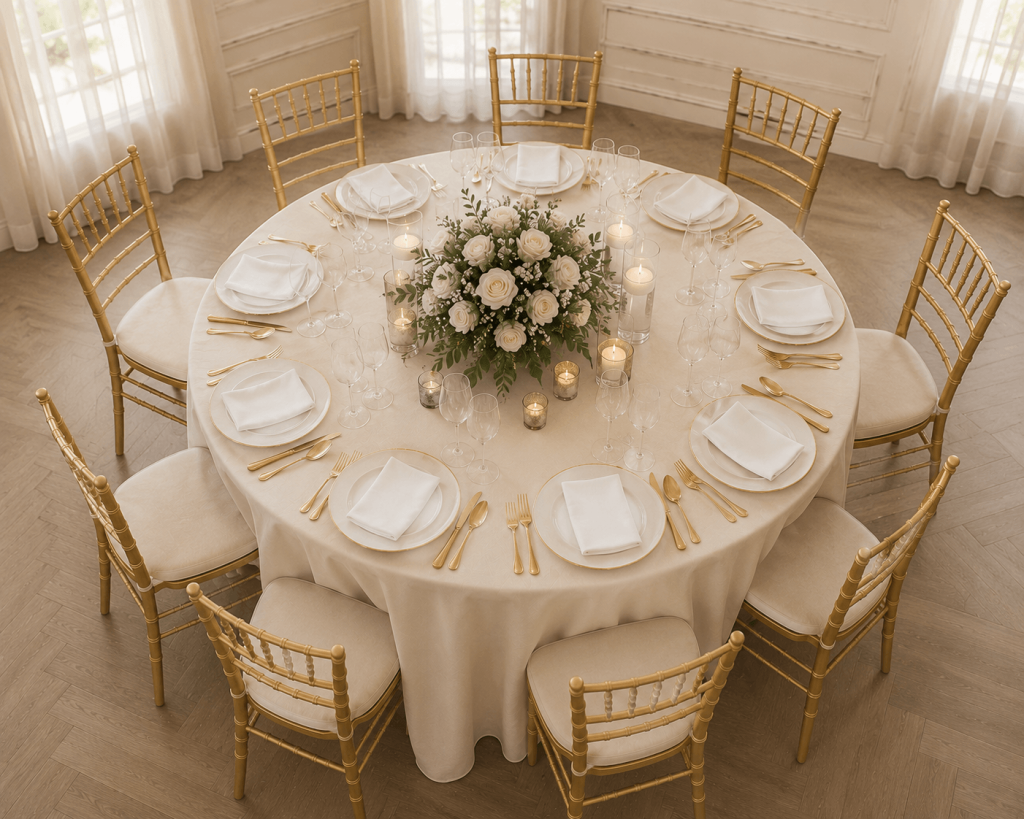
Choosing between a 5ft and 6ft round table sounds like a fairly minor wedding-planning decision.
It isn’t.
Your table size affects how many tables you need, how spacious your reception feels, how easily guests can talk to one another, the number of centrepieces you need and, importantly, how many chairs can be positioned comfortably within your venue.
For some weddings, 5ft round tables are the obvious choice. For others, moving to 6ft tables can make a large guest list considerably easier to organise.
The mistake is choosing purely on the basis of:
“A 6ft table holds more people, so we’ll need fewer tables.”
That’s true, but it doesn’t necessarily mean the resulting layout will be better.
Let’s look at the differences properly.
5ft vs 6ft Round Tables at a Glance
As a general starting point for formal events:
| 5ft Round Table | 6ft Round Table | |
|---|---|---|
| Approx. diameter | 152cm | 183cm |
| Comfortable starting point | Around 8 guests | Around 10 guests |
| Floor footprint | Smaller | Larger |
| Guest group | More intimate | Larger |
| Centrepiece space | Good | More generous |
| Number of tables required | More | Fewer |
| Best suited to | Flexible/tighter layouts | Larger guest groups |
These aren’t absolute capacities.
Different chairs, table designs, place settings and venue layouts can change the practical number of people you should seat around each table.
The objective shouldn’t be to find the maximum possible capacity.
It should be to find the arrangement that works best for your particular wedding.
What Is a 5ft Round Wedding Table?
A 5ft table is approximately 152cm across.
It’s one of the most familiar table sizes used at UK weddings, dinners and events.
With Chiavari chairs, around eight guests is a useful comfortable starting point for a formal wedding breakfast.
That gives you a table that feels reasonably intimate without making place settings unnecessarily cramped.
For many weddings, it’s an extremely versatile combination.
Why Choose 5ft Round Tables?
1. Smaller Groups Can Feel More Sociable
This is an advantage people don’t always consider.
At a table of eight, guests are generally closer together than they would be around a larger table.
That can make conversation easier.
For weddings where you’ve carefully grouped:
- Families
- School friends
- University friends
- Work colleagues
- Family friends
smaller tables can create quite a natural atmosphere.
You aren’t simply choosing furniture dimensions.
You’re partly determining how your guests interact during the meal.
2. They’re Easier to Position Around Awkward Rooms
Not every wedding takes place in a perfectly rectangular ballroom.
You may have:
- Pillars
- Fireplaces
- Alcoves
- Bay windows
- Structural columns
- Fixed bars
- Stages
- Unusual room shapes
A smaller table gives your planner or venue more flexibility.
This can be particularly useful in older London hotels, country houses and historic wedding venues where the architecture dictates the layout.
3. They Can Make Smaller Venues Feel Less Crowded
A 6ft table is only one foot wider in diameter, but that difference applies around the entire table.
Once chairs and seated guests are added, the overall footprint becomes considerably larger.
In a smaller reception room, 5ft tables may allow you to maintain better:
- Walkways
- Catering routes
- Access to the bar
- Dance-floor space
- Distance between guests
A smaller table can therefore create a more comfortable room even if you technically require more of them.
4. Eight Guests Often Works Nicely for Seating Plans
Guest groups rarely divide perfectly into tens.
You may naturally have groups such as:
- 7 close friends
- 8 relatives
- 6 colleagues
- 8 cousins
Trying to force every group into a ten-person arrangement can sometimes result in strange combinations.
Smaller tables can give you more flexibility when constructing the seating plan.
Are There Disadvantages to 5ft Tables?
Yes.
The biggest is simple:
You’ll generally need more tables.
If you have 200 guests and seat approximately eight per table, you’re looking at around 25 guest tables before adjusting for your top table and specific seating plan.
At ten per table, you’d need around 20.
Five additional tables potentially means:
- Five additional centrepieces
- Five additional tablecloths
- Five additional table numbers
- More décor
- More table setup
So while the individual table is smaller, the overall event may require more furniture and styling.
What Is a 6ft Round Wedding Table?
A 6ft round table is approximately 183cm across.
For many formal wedding arrangements, around ten guests provides a useful starting point.
The additional diameter gives you more circumference for guests and considerably more tabletop area.
This makes 6ft tables particularly useful for larger celebrations.
Why Choose 6ft Round Tables?
1. You Can Seat More Guests Per Table
This is the obvious advantage.
At a large wedding, moving from eight to ten guests per table can significantly reduce the total number of tables required.
Consider 240 guests.
At eight per table:
30 tables
At ten per table:
24 tables
That’s six fewer guest tables.
For a large ballroom, that can make a substantial difference to the layout.
2. More Space for Table Styling


Modern wedding tables can contain much more than plates and cutlery.
You might have:
- Charger plates
- Multiple glasses
- Menus
- Favours
- Candles
- Table numbers
- Floral arrangements
- Wine
- Water
- Decorative elements
The extra surface area of a 6ft table gives your stylist more room to work.
This can be particularly valuable for luxury weddings with substantial tablescapes.
3. They’re Useful for Large Weddings
Once guest numbers move into the hundreds, table efficiency becomes increasingly important.
This is especially relevant for:
- Large Asian weddings
- Hotel ballroom weddings
- Gala dinners
- Charity balls
- Awards ceremonies
Reducing the total number of tables can simplify the floorplan considerably.
But that only works when the venue itself has enough space for the larger table footprint.
The Main Disadvantage of 6ft Tables: They Are Big
This sounds obvious, but it’s frequently underestimated.
A 6ft table isn’t just a slightly bigger 5ft table.
You need to accommodate:
6ft table + chairs + seated guests + circulation space.
Place two occupied tables too close together and guests sitting back-to-back can quickly reduce the usable walkway.
A floorplan containing 15 large circles may look spacious on screen.
Once 150 guests are actually sitting around those circles, the room can feel very different.
Which Takes Up More Space Overall?
This is where there isn’t a universal answer.
You might assume that because you need fewer 6ft tables, they always save room.
Not necessarily.
Each 6ft table occupies more floor area.
Whether 5ft or 6ft tables produce the more efficient overall layout depends on:
- Room dimensions
- Room shape
- Guest count
- Chair dimensions
- Number of tables
- Required circulation space
This is why we recommend working from a scaled venue floorplan rather than choosing table size purely through arithmetic.
Let’s Compare a 100-Guest Wedding
For simplicity, assume all 100 guests are seated at round guest tables.
Option A: 5ft tables
At approximately eight per table, you’ll need around 13 tables.
You could distribute guests something like:
8 + 8 + 8 + 8 + 8 + 8 + 8 + 8 + 8 + 8 + 8 + 6 + 6
You don’t need to maximise every table.
Option B: 6ft tables
At ten per table:
10 tables
This is extremely neat mathematically.
But whether those ten larger tables produce a better room is something only the venue floorplan can answer.
What About a 150-Guest Wedding?
At approximately eight per 5ft table:
Around 19 tables
At approximately ten per 6ft table:
Around 15 tables
That’s four fewer tables.
If you’re spending £150 on flowers and styling for each centrepiece, the table quantity itself could affect your décor budget significantly.
But if the 6ft tables force you to reduce your dance floor, that saving may suddenly look less attractive.
Everything is connected.
And a 300-Guest Wedding?
This is where the difference becomes much more noticeable.
At eight per 5ft table:
Around 38 tables
At ten per 6ft table:
Around 30 tables
That’s approximately eight fewer tables.
For a large Asian wedding, gala dinner or substantial hotel reception, this can influence:
- Centrepiece quantities
- Linen quantities
- Table numbering
- Catering routes
- Stage visibility
- Dance-floor positioning
- Overall room design
At this scale, furniture planning should form part of the overall event production rather than being treated as an isolated hire order.
Which Table Is Better for Chiavari Chairs?
Both.
Chiavari chairs work particularly well around round tables because their relatively slim frame doesn’t visually overpower the table.
But the chair finish can change the overall character of the setup.
Gold Chiavari Chairs
Gold works beautifully with formal round-table arrangements in:
- Hotel ballrooms
- Banqueting suites
- Luxury wedding venues
Pair them with white or ivory linen, candles and warm lighting and you get the classic formal wedding look.
Limewash Chiavari Chairs


Limewash works particularly well for:
- Marquees
- Barns
- Country houses
- Garden weddings
The softer timber appearance can make round tables feel less formal and more natural.
White Chiavari Chairs
White works well where you’re trying to create a light, fresh room.
They can be particularly effective for summer weddings and venues with contemporary interiors.
Black Chiavari Chairs
Black creates stronger contrast and can suit contemporary weddings, corporate dinners and evening events.
What About Centrepieces?
Your florist should ideally know your table dimensions before finalising centrepiece designs.
A centrepiece designed for a 6ft table can look disproportionately large on a 5ft table.
Equally, something designed for a smaller table can look lost in the centre of a large 6ft arrangement.
Think about the relationship between:
table → chairs → centrepiece → place settings.
They should look like one composition.
Does a 6ft Table Make Conversation More Difficult?
Potentially.
Guests are sitting further apart across a larger diameter.
That doesn’t mean 6ft tables aren’t sociable — they’re used successfully at thousands of weddings — but it is something worth considering.
Large or very dense centrepieces can compound the issue.
If you use tall floral arrangements, designing them so guests can see beneath the flowers can help maintain sightlines across the table.
Which Is Better for a Marquee Wedding?
Both can work extremely well.
The advantage of a marquee is that you often begin with a relatively clean rectangular space.
That makes systematic table layouts easier to design.
For a smaller marquee, 5ft tables may help preserve circulation.
For a substantial marquee wedding with hundreds of guests, 6ft tables may reduce the number of individual tables required.
Long banquet tables are another option worth considering for marquee weddings.
Which Is Better for a London Hotel Wedding?
This depends heavily on the ballroom.
Large London hotels may have substantial banqueting rooms designed around large round tables.
In those environments, 6ft tables can work beautifully.
Smaller private rooms may benefit from 5ft tables.
London venues can also contain:
- Structural pillars
- Stages
- Fixed bars
- AV equipment
- Dance floors
- Production installations
These all reduce the floor area actually available for dining.
Never base furniture quantities purely on the venue’s headline capacity.
Don’t Forget the Dance Floor
This is a common planning trap.
You create a beautiful seating layout and realise afterwards that the dance floor has become too small.
For many weddings, the evening celebration is a major part of the event.
Decide early how much space you want to dedicate to:
- Dance floor
- DJ
- Band
- Stage
- Entertainment
Then plan dining furniture around those areas.
Don’t treat the dance floor as whatever space remains after the tables have been positioned.
Catering Routes Matter Too
Waiting staff need to move efficiently between tables.
They may be carrying several plates or trays of drinks.
A layout that forces them through narrow gaps between occupied chairs can:
- Slow service
- Interrupt guests
- Increase the risk of accidents
Ask your venue or caterer to review the floorplan if you’re working close to maximum capacity.
Their practical experience can be extremely valuable.
Think About Your Seating Plan Before Choosing
There’s another way to approach the decision.
Look at your natural guest groups.
Suppose you have:
- 8 university friends
- 8 work colleagues
- 7 cousins
- 8 family friends
Five-foot tables may make enormous sense.
Alternatively, perhaps your guest groups naturally fall into groups of nine and ten.
Six-foot tables may simplify the seating plan.
Don’t force your relationships to fit your furniture.
Let your guest list inform the furniture choice too.
Can You Mix 5ft and 6ft Tables?
Potentially, yes.
There is no rule requiring every guest table to be identical in size.
A mixed layout can sometimes solve awkward guest-number problems or help work around venue architecture.
However, visually, the room should still feel intentional.
If you’re mixing sizes, consider:
- Consistent linen
- Matching Chiavari chairs
- Coordinated centrepieces
- Balanced positioning
Your planner or stylist can help prevent the room from looking randomly assembled.
What About the Top Table?
Your top table doesn’t necessarily need to follow the same format.
You could have:
- Traditional straight top table
- Sweetheart table
- Round family table
- Curved table
- Banquet-style arrangement
Remember to remove those guests from your round-table calculations before determining quantities.
A 150-person wedding with ten people at the top table doesn’t require round-table seating for 150.
It requires it for approximately 140.
That difference can remove an entire table from your order.
A Practical Decision Checklist
Choose 5ft tables when you value:
- Smaller guest groups
- More flexible positioning
- Easier use in irregular rooms
- A more intimate dining atmosphere
Consider 6ft tables when you value:
- More guests per table
- Fewer overall tables
- More generous tabletop space
- Efficient planning for larger guest numbers
But before making the final choice, check:
- Venue dimensions
- Guest count
- Seating groups
- Chair dimensions
- Dance-floor requirement
- Catering routes
- Centrepiece dimensions
- Accessibility
- Stage/entertainment space
- Actual scaled floorplan
Frequently Asked Questions
How many people can sit around a 5ft round wedding table?
Around eight guests is a useful comfortable starting point for many formal wedding layouts. Depending on the furniture and event style, additional guests may sometimes be accommodated.
How many people can sit around a 6ft round wedding table?
Around ten guests is commonly used as a comfortable planning point, although exact capacity depends on the table, chairs and place settings.
Is a 6ft round table too big for eight people?
Not necessarily. Eight guests around a 6ft table creates a generous arrangement. Whether it looks appropriate depends on the centrepiece and table styling.
Are 5ft tables better for small weddings?
They can be particularly useful because their smaller footprint offers more flexibility, but the best choice depends on the venue rather than simply the number of guests.
Can you mix 5ft and 6ft tables at a wedding?
Yes, if the venue layout and seating plan benefit from it. Consistent chairs, linen and styling can help the mixed sizes still look cohesive.
So, Should You Choose 5ft or 6ft Round Tables?
There isn’t a universal winner.
For one wedding, 5ft tables with eight Chiavari chairs may create the perfect balance of intimacy and space.
For another, 6ft tables with ten chairs may make a 300-person ballroom considerably easier to organise.
The best decision comes from looking at the event as a whole:
How many guests are coming? How large is the room? How do you want people grouped? How much dance-floor space do you need? What style of table setting are you creating?
Answer those questions first.
Then choose the furniture.
At Chiavari Chairs Hire, we supply Chiavari chairs and event furniture across London and the South East. If you have your venue, wedding date and approximate guest count, we can help you work out the furniture quantities required for your event.
Planning an event?
Skip the reading and get a price. Send your date, venue and rough numbers.
Get a quote