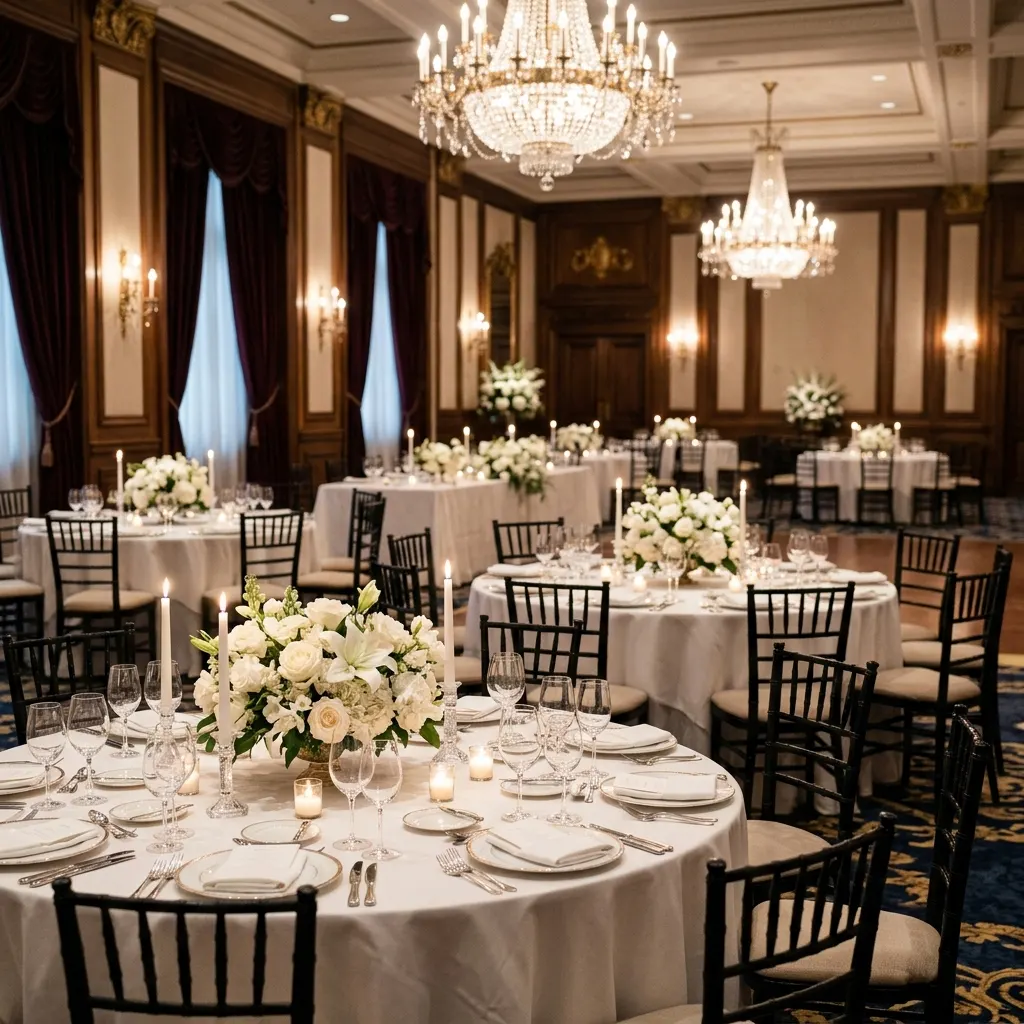
When planning a wedding, it can seem unnecessary to hire two complete sets of chairs.
If you have 150 guests at your ceremony and those same 150 guests are attending the wedding breakfast, why not simply move the ceremony chairs into the reception room?
In many cases, you absolutely can.
Reusing your wedding chairs can reduce the amount of furniture you need to hire and make particularly good sense when the ceremony and reception take place at the same venue.
But there is an important difference between something being possible and it being practical.
Moving 20 chairs is easy. Moving 150 or 200 Chiavari chairs, resetting them around dining tables and having the reception room completely ready before your guests arrive requires considerably more planning.
Before deciding whether to use one set of chairs for your entire wedding, you need to consider timing, distance, staffing, venue access and what your guests will be doing while the room is being changed.
Here is what you need to know.
Can You Use the Same Chairs for Your Wedding Ceremony and Reception?
Yes.
Chiavari chairs are particularly suitable for this because they are relatively lightweight and designed for event use.
If your ceremony takes place in one part of a venue and your reception takes place nearby, the chairs can potentially be moved after the ceremony and arranged around your dining tables.
For some weddings, this is straightforward.
For example:
Ceremony → drinks reception → wedding breakfast
If guests spend 90 minutes enjoying drinks and photographs in a separate area after the ceremony, that may provide the venue team with enough time to transform the reception space.
But every wedding is different.
The first thing to establish is exactly how much time exists between the end of your ceremony and the moment guests need the chairs again.
Why Couples Consider Reusing Their Wedding Chairs
The obvious reason is cost.
Suppose you have 150 wedding guests.
If separate chairs are required for the ceremony and reception, you could potentially require:
150 ceremony chairs + 150 reception chairs = 300 chairs.
If the same 150 chairs can be moved successfully, you may only need to hire one set.
That can reduce:
- Furniture hire costs
- Delivery volume
- Storage requirements
- The amount of furniture required at the venue
However, the calculation isn’t quite as simple as comparing 150 chairs with 300.
Someone still needs to move them.
And that introduces another cost: labour and time.
The Most Important Question: How Much Turnaround Time Do You Have?
This should determine the decision more than anything else.
Imagine your ceremony finishes at 2:30pm.
Guests then move outside for drinks, canapés and photographs.
The wedding breakfast begins at 4:30pm.
You potentially have around two hours to move the furniture.
That could be perfectly manageable.
Now imagine:
- Ceremony ends at 3:00pm
- Reception doors open at 3:30pm
Thirty minutes is a completely different situation.
Within that period, the team may need to:
- Wait for guests to leave the ceremony area.
- Remove any chair decorations.
- Move the chairs.
- Transport them into the reception space.
- Position them around tables.
- Check table numbers and seating arrangements.
- Align the chairs.
- Make final adjustments.
- Clear equipment and staff from the room.
- Have everything presentation-ready before guests enter.
For a large wedding, that can become a substantial operation.
Who Is Actually Going to Move the Chairs?
This is the question that is surprisingly easy to forget.
Don’t assume your venue, wedding planner or chair hire company will automatically move them.
Before choosing a single-set arrangement, establish exactly who is responsible.
Possible options include:
- Venue staff
- Wedding planner’s team
- Furniture hire team
- Dedicated event crew
What you don’t want is your bridesmaids, groomsmen or family members carrying chairs between rooms while everyone else is enjoying the drinks reception.
Your wedding day shouldn’t depend on guests becoming an impromptu furniture-moving team.
Does Your Venue Allow Chairs to Be Moved?
You should also speak to your venue before making the decision.
Some venues have strict rules regarding:
- Furniture movement
- Supplier access
- Floor protection
- Which staff can handle hired equipment
- Movement between indoor and outdoor areas
Historic properties may be particularly careful about furniture being carried across delicate floors or through narrow interiors.
Hotels may have different restrictions because corridors and service lifts are being used simultaneously by staff and other guests.
Always ask.
How Far Do the Chairs Need to Travel?
Distance makes an enormous difference.
Consider these two scenarios.
Scenario A: Adjacent Rooms
Your ceremony takes place in one ballroom and the wedding breakfast is in the ballroom immediately next door.
This may be relatively straightforward.
Scenario B: Outdoor Ceremony
Your ceremony takes place in a garden 150 metres from the main building.
Now 150 chairs need to travel:
Garden → pathway → building entrance → corridor → reception room.
If there are steps, gravel, slopes or narrow doorways along the route, the operation becomes considerably slower.
And if the weather suddenly changes, the chairs may need moving even faster.
Moving Outdoor Ceremony Chairs Requires Extra Planning


Outdoor weddings create some of the most beautiful Chiavari chair setups, particularly with limewash and white finishes.
But outdoor furniture movement introduces additional considerations.
You need to think about:
- Ground conditions
- Distance from the building
- Weather
- Steps
- Gravel
- Grass
- Whether chair legs need cleaning before entering the reception room
If the ground becomes wet, you don’t necessarily want chairs carried directly from damp grass onto an immaculate ballroom floor.
Your venue and hire supplier should agree how this will be managed.
What Happens to the Chair Decorations?
If your ceremony chairs are decorated, those details also need considering.
You might have:
- Flowers
- Ribbons
- Fabric
- Reserved signs
- Aisle arrangements
- Bride and groom signs
Will those decorations remain attached during the reception?
If not, somebody needs to remove them before the chairs are moved.
That adds another stage to the turnaround.
Your florist may also need to collect or reposition floral arrangements at exactly the same time the furniture team is trying to move the chairs.
This is why supplier coordination matters.
Can You Move Chiavari Chairs With the Cushions Attached?
Often, yes, depending on the particular chair and cushion fastening.
However, the supplier or setup team should determine the safest and most efficient way to move their furniture.
If cushions become loose while chairs are being carried, you’ll create another job at the reception end: finding, replacing and aligning them.
For a large wedding, even an extra 20 seconds per chair becomes meaningful when multiplied by 200 chairs.
Will Moving the Chairs Disrupt Your Drinks Reception?
One of the reasons wedding planners carefully consider furniture movement is that the transition shouldn’t become part of the guest experience.
Ideally, your guests shouldn’t notice it happening.
If the route between the ceremony and reception requires staff carrying chairs directly through the middle of your drinks reception, the atmosphere can quickly feel less polished.
Imagine guests standing with champagne while teams repeatedly carry stacks of furniture through the same space.
It may be completely manageable behind the scenes, but if the only available route passes through guest areas, hiring separate chairs could produce a much smoother experience.
What About Wedding Photography?
This is another small detail that can become important.
Immediately after the ceremony, photographers often take:
- Couple portraits
- Family photographs
- Wedding party photographs
- Ceremony-detail photographs
If the photographer wants photographs around the ceremony setup, you may not want the furniture dismantled the second the final guest stands up.
Similarly, your videographer may be capturing the transition between ceremony and drinks reception.
Discussing timings beforehand prevents suppliers from working against one another.
When Reusing the Same Wedding Chairs Works Best
Using one set of chairs tends to work particularly well when:
1. The ceremony and reception are at the same venue
No vehicles are required to transfer furniture between locations.
2. The spaces are close together
Adjacent rooms or a short internal route make movement considerably easier.
3. There is a generous drinks reception
An hour and a half or more can provide a useful working window, depending on guest numbers and venue logistics.
4. A professional team is responsible for the move
Everyone knows who is moving the chairs and when.
5. The chairs aren’t heavily decorated
Less needs removing and resetting.
6. Guest numbers are manageable
Moving 60 chairs is very different from moving 400.
When Separate Ceremony and Reception Chairs May Be Better
There are situations where hiring additional chairs can be worth the extra cost.
Very Large Weddings
For a 300, 400 or 500-person celebration, moving every chair can become a significant logistical exercise.
Large Asian weddings are a good example.
If hundreds of guests need to move rapidly between different event spaces, having the reception room already completely prepared can remove considerable pressure from the schedule.
Very Short Turnarounds
If guests are moving almost immediately from ceremony to dining, there simply may not be enough time.
A beautifully prepared reception room waiting for guests is preferable to keeping them outside because furniture is still being arranged.
Long Distances Between Spaces
If the chairs need to travel across substantial grounds, through multiple floors or between separate buildings, the labour involved may outweigh the saving.
Complex Reception Styling
If your reception tables have elaborate décor, place settings and centrepieces, the styling team may want the chairs positioned early so they can see and perfect the finished room.
Waiting until after the ceremony could interfere with their work.
Completely Different Chair Styles
Sometimes the design itself answers the question.
You might want:
White or limewash Chiavari chairs for the ceremony
and:
Gold Chiavari chairs for the ballroom reception.
In that case, two sets aren’t simply a logistical decision — they’re part of the wedding design.
Could You Use the Venue’s Ceremony Chairs Instead?
There is another option that couples sometimes overlook.
If your venue already provides suitable ceremony seating, you could use:
Venue chairs for ceremony + hired Chiavari chairs for reception.
This means your reception can be fully prepared long before the ceremony begins without necessarily hiring two sets yourself.
Whether this works depends on the appearance and quality of the venue’s chairs.
Ask to see them rather than assuming they’ll match the photographs in the venue brochure.
One Set vs Two Sets: A Simple Comparison
| Consideration | One Set of Chairs | Separate Sets |
|---|---|---|
| Hire quantity | Lower | Higher |
| Furniture hire cost | Usually lower | Usually higher |
| Labour required during turnaround | Higher | Lower |
| Reception can be completed early | No | Yes |
| Suitable for tight turnaround | Less suitable | Better |
| Flexibility of chair styles | Limited | Greater |
| Risk of delays affecting reception | Higher | Lower |
| Best for nearby event spaces | Yes | Not essential |
The cheapest furniture option isn’t automatically the best overall solution.
Look at the complete logistics of the day.
Example: A 120-Guest Country House Wedding
Imagine you’re planning a wedding for 120 people.
The ceremony takes place outside at 1:30pm.
It finishes around 2:15pm.
Guests move to a terrace for drinks and canapés.
The wedding breakfast begins at 4:30pm in the main dining room.
In this situation, using the same Chiavari chairs could work extremely well.
There is a substantial turnaround window and guests are occupied elsewhere.
If the route from the ceremony lawn to the dining room is short and a team has been assigned to the move, hiring 120–125 chairs rather than 240 could be perfectly practical.
Example: A 300-Guest London Wedding
Now consider 300 guests attending a ceremony in one event space followed shortly afterwards by a reception in another.
The venue has:
- Restricted service lifts
- Limited supplier corridors
- A 45-minute turnaround
- Catering teams preparing the reception simultaneously
Moving 300 chairs within that window may technically be possible with enough staff, but it creates significantly more risk.
In that situation, having the reception chairs installed beforehand could be worth the additional hire cost simply because it removes a major dependency from an already busy turnaround.
Don’t Forget Spare Chairs
Whether you’re using one or two sets, discuss spare-chair requirements with your supplier.
Guest numbers can change.
A chair could need replacing.
A table arrangement may change.
You don’t necessarily need dozens of unnecessary extras, but having an agreed contingency can be useful, particularly at larger events.
Questions to Ask Before Deciding
Before committing to moving your ceremony chairs, speak to your venue, planner and furniture supplier and establish:
- How many chairs are being moved?
- How much time is available?
- Who is responsible for moving them?
- How far do they need to travel?
- Are there stairs or lifts?
- Is any part of the route outdoors?
- Will the move cross guest areas?
- Does the venue permit it?
- Are decorations attached to the chairs?
- When does the reception room need to be completely ready?
- Will florists, caterers or AV teams be working in the room simultaneously?
- Is the saving worth the additional turnaround pressure?
Once those questions are answered, the right choice is usually quite clear.
Frequently Asked Questions
Can Chiavari chairs be moved from a wedding ceremony to the reception?
Yes. Their relatively lightweight event-focused design makes Chiavari chairs well suited to being repositioned. However, the feasibility depends on quantity, distance, staffing and the time available between the ceremony and reception.
Is it cheaper to use the same wedding chairs all day?
It can be because fewer chairs need to be hired. However, you should also consider any additional labour required to move and reset the chairs.
Who normally moves wedding chairs?
It varies between weddings. It may be the venue, event planner, furniture supplier or another event crew. Never assume this is included — confirm responsibility before the wedding.
How long does it take to move 100 wedding chairs?
There isn’t a reliable universal time because moving 100 chairs between adjacent rooms is very different from moving them from an outdoor ceremony across a large estate. Ask your supplier or venue to assess your actual route and setup.
Should I hire separate ceremony and reception chairs?
Separate sets can be worthwhile when you have a short turnaround, large guest numbers, difficult access, different chair styles or want the reception completely styled before the ceremony begins.
So, Should You Move Your Wedding Chairs?
For many weddings, yes.
If the ceremony and reception are close together, you have a sensible turnaround window and a professional team is responsible for moving the furniture, using the same Chiavari chairs can be an efficient way to manage your hire requirements.
But don’t choose that approach purely because it means hiring fewer chairs.
For some weddings, particularly large celebrations and events with tight turnarounds, having two spaces completely set up in advance can be far more valuable than the saving achieved by moving one set.
The right answer depends on your venue, guest numbers, timings and event schedule.
At Chiavari Chairs Hire, we provide Chiavari chair hire across London and the South East for ceremonies, wedding breakfasts and receptions. If you send us your venue, event date, guest numbers and planned timings, we can help you work out the most practical chair requirement for your event.
Planning an event?
Skip the reading and get a price. Send your date, venue and rough numbers.
Get a quote